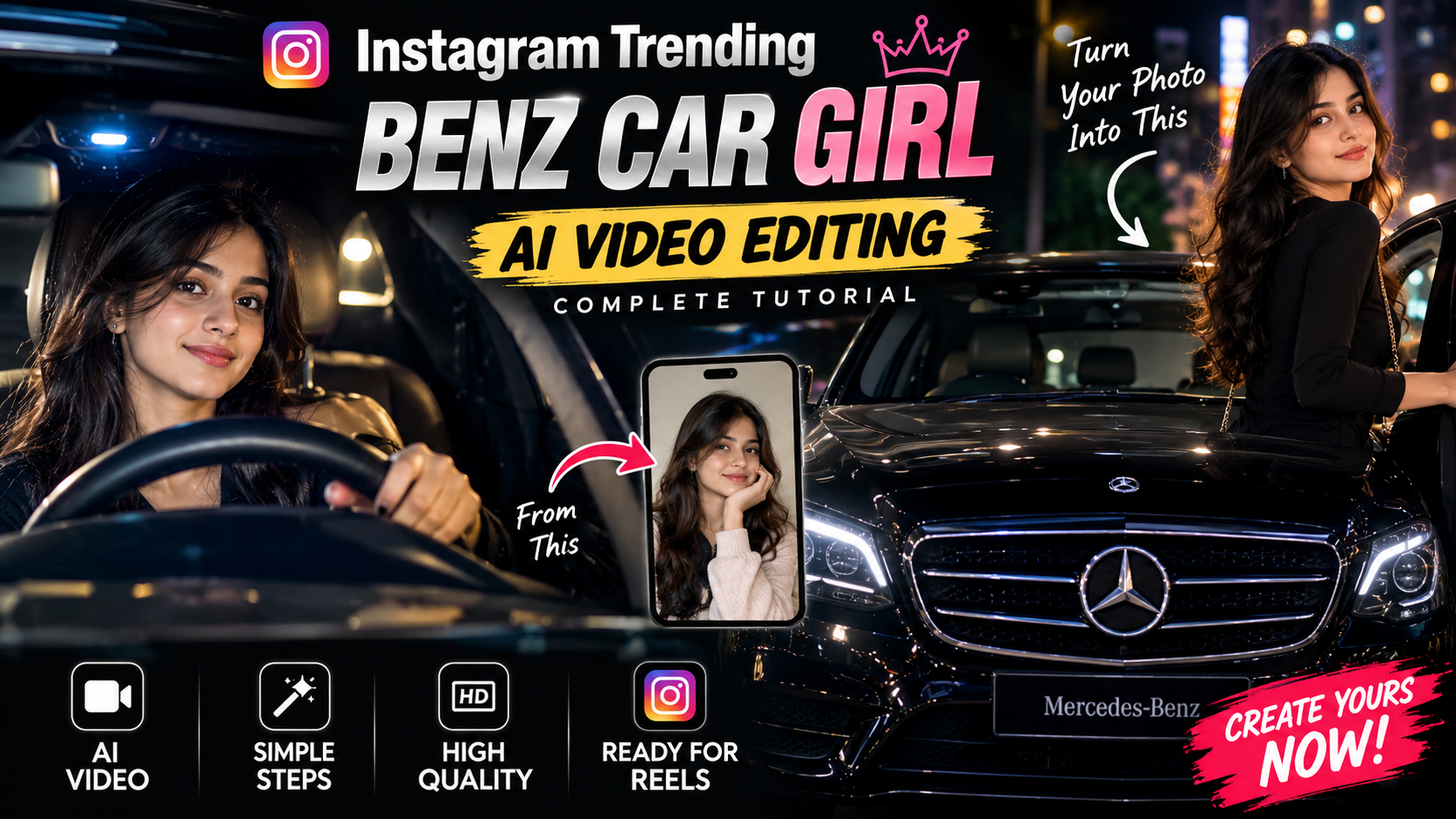
Instagram Trending Benz Car Girl AI Video Editing 2026
Have you seen stylish Mercedes-Benz car videos featuring a girl sitting inside a luxury car, looking confidently at the camera, making natural facial expressions, or posing beside the vehicle? This type of cinematic car content is a creative format that can be recreated using AI video-generation tools.
If you want to create your own Mercedes-Benz car girl video for Instagram Reels, this guide explains how to prepare your photos, use reference videos, write AI prompts, and edit the final result for social media.
You can experiment with different outfits, car interiors, camera angles, lighting effects, and video styles to create a personalized result.
Content note: AI-generated examples should be presented as AI creations rather than genuine footage of a person driving a real vehicle.
What Is the Benz Car Girl AI Video Editing Trend?
Mercedes-Benz car girl editing is a luxury-car-themed video concept in which a woman is shown inside or beside a premium car. AI tools can help create scenes with cinematic lighting, smooth camera movements, realistic-looking car interiors, and expressive character movements.
Creators can use this concept for:
-
Instagram Reels and short-form videos.
-
Luxury lifestyle edits and fashion content.
-
AI photo-to-video transformations.
-
Cinematic car edits with music and transitions.
-
Creative videos using personal photos as character references.
The final appearance depends on the reference images, prompt instructions, and capabilities of the selected AI tool.
How to Create a Mercedes-Benz Girl AI Video Using Your Photo


Follow these steps to create your own version of the car girl video.
-
Step 1: Select a clear character photo
Choose a good-quality photo in which the person’s face is clearly visible. A well-lit portrait or suitable upper-body photo can help the AI tool maintain the character’s appearance.
-
Step 2: Choose a reference video
If your AI tool supports video references, select a clip that demonstrates the camera angle, movements, expressions, and timing you want to recreate.
-
Step 3: Open a compatible AI video tool
Use an image-to-video or reference-guided video generator. Google Flow is one option to explore, depending on its current availability and supported features.
-
Step 4: Upload your reference materials
Upload your character image and, if supported, your reference video. Use images and footage you own or have permission to use.
-
Step 5: Copy and customize the prompt
Use the prompt below as a starting point. Adjust the outfit, car color, lighting, and actions to suit your preferred style.
-
Step 6: Generate and review the video
Check the character’s face, hands, car proportions, steering wheel, reflections, and movement. Regenerate or simplify the instructions if the result contains visible errors.
-
Step 7: Edit for Instagram Reels
Add suitable music, text, and transitions using a compatible editing app. Export in a vertical format when creating a Reel.
Copy-Paste AI Video Editing Prompt
REFERENCE VIDEO
Genarate Ai Video
PROMPT :
Create an ultra-realistic REAL-WORLD CAMERA VIDEO, not an AI-looking or CGI-looking video. Use TWO uploaded references: REFERENCE VIDEO: This controls the exact car, car movement, camera movement, camera angle, framing, timing, scene transition, environment, lighting, actions and overall visual composition. CHARACTER IMAGE: This controls the exact identity and appearance of the person. The final result must look like an actual real camera recording of a real person inside a real physical Mercedes-Benz car. IMPORTANT — DO NOT GENERATE A 3D RENDER: The car must NOT look computer-generated, game-engine rendered, 3D modeled or digitally reconstructed. The person must NOT look AI-generated, plastic, overly smooth, beautified or digitally composited. Everything must have the small imperfections and optical characteristics of genuine real-world camera footage. REAL CAMERA LOOK: Use physically believable camera optics and real-world photography characteristics. Natural exposure. Natural dynamic range. Natural highlight roll-off. Realistic motion blur. Realistic shutter motion. Natural depth of field. Natural lens distortion. Natural focus transition. Realistic sensor noise/grain at a very subtle level. Natural skin texture. Natural micro-contrast. Realistic reflections. Realistic shadows. Realistic ambient light. Do NOT make the image excessively sharp, glossy, HDR, oversaturated or digitally perfect. Avoid the typical AI-generated “perfect image” appearance. REAL HUMAN: The uploaded person must look like a real human being physically present inside the car. Preserve the exact identity from the uploaded image: same face shape, same eyes, same eyebrows, same nose, same lips, same jawline, same skin tone, same hairstyle, same facial hair, same age, same natural facial proportions. Preserve realistic skin pores, tiny skin imperfections, natural facial asymmetry and realistic skin texture. Do not smooth the skin. Do not beautify. Do not reshape the jaw. Do not enlarge the eyes. Do not change the nose. Do not modify the lips. Do not make the face symmetrical. Do not make the person look like an AI model. The person’s face must remain stable throughout the entire video. REAL EYES AND FACE: Eyes must have realistic wetness, reflections and natural blinking. Facial expressions must be produced through subtle realistic facial muscle movement. No frozen expression. No rubber-like facial movement. No face warping. No identity drift. REAL HAIR: Individual hair strands should behave naturally. Hair must respond naturally to head movement and airflow. Do not create painted or plastic-looking hair. REAL HANDS: Hands must have physically correct anatomy. Five fingers on each hand. Natural finger joints. Natural skin texture. Realistic fingernails. Correct hand proportions. Natural wrist movement. No extra fingers. No fused fingers. No malformed palms. No disappearing fingers. REAL MERCEDES: The black Mercedes-Benz must look like an actual photographed physical vehicle. Preserve realistic: metallic black paint, clear-coat reflections, chrome grille, Mercedes emblem, LED headlights, windshield glass, side mirrors, body panels, panel gaps, rubber seals, tires, dashboard, steering wheel, leather seats, interior materials. The paint must reflect the real surrounding environment naturally. Do NOT make the bodywork look like a smooth CGI model. Do NOT create impossible reflections. The windshield must behave like real glass: realistic transparency, realistic reflections, subtle tint, correct refraction, natural highlights and glare. CAR MOVEMENT: Recreate the exact vehicle movement from the uploaded reference video. When the car approaches the camera, its apparent size must increase because of REAL PHYSICAL MOVEMENT through space — NOT because of a digital zoom. The grille, headlights, hood and windshield must naturally become larger in the frame as the vehicle approaches. Perspective must change naturally according to the changing distance between the real camera and the real car. Maintain realistic wheel/body motion and natural vehicle movement. Do not make the car slide. Do not make the car float. Do not make the car move like a 3D animation. CAMERA: Reproduce the reference video’s camera position and movement exactly. The camera must behave like a real handheld or mounted camera physically positioned in the real environment. Match: camera height, camera distance, lens perspective, field of view, framing, camera movement, camera speed, camera acceleration/deceleration, focus behavior, motion blur, and timing. Do not invent camera movements. Do not use artificial digital zoom to imitate physical camera movement. Do not orbit around the car unless the reference video does so. Do not create drone-like movement unless present in the reference. SCENE 1 — EXTERIOR: Recreate the opening exterior shot exactly from the reference video. The real black Mercedes approaches the camera. Maintain the same front-facing composition and camera position as the reference. As the vehicle comes closer, naturally reveal more detail in: grille, Mercedes emblem, headlights, hood, windshield and driver. The driver must remain physically inside the real vehicle. Realistic windshield reflections should partially interact with the driver’s face without completely hiding it. Maintain natural daylight and real environmental reflections. SCENE 2 — EXACT TRANSITION: At the same moment as the reference video, transition/cut to the interior shot. Do not invent a new transition. SCENE 3 — INTERIOR: Recreate the exact interior composition from the reference. The uploaded person sits naturally in the driver’s seat. Show the real steering wheel in the foreground. Show realistic dashboard materials and beige/cream leather interior. The person looks naturally toward the side, then toward the front/camera according to the reference. One hand remains naturally positioned on or around the steering wheel when appropriate. SCENE 4 — HUMAN MOVEMENT: Recreate the exact hand gesture, head movement, eye movement and smile from the reference video. Movement must be subtle and physically realistic. Natural blinking. Natural breathing. Natural shoulder movement. Natural head rotation. Natural facial muscle movement. SCENE 5 — FINAL EXPRESSION: Recreate the final expression and head position from the reference. The person gives a subtle natural smile. Do not exaggerate the expression. Keep the same face identity and realistic skin texture. LIGHTING: Match the real lighting conditions visible in the reference video. Use physically believable daylight. Light must naturally interact with: skin, hair, glass, metal, paint, chrome, dashboard, steering wheel and leather. Shadows must have realistic softness and direction. No artificial studio lighting. No excessive cinematic glow. No fake rim light. No neon lighting unless it exists in the reference. COLOR: Natural real-camera color science. Realistic skin tones. Realistic black car paint. Natural beige interior. Natural highlights and shadows. Avoid excessive saturation. Avoid excessive contrast. Avoid HDR appearance. Avoid Create a highly realistic 10-second cinematic video using the reference image/person as the exact identity reference.
IMPORTANT:
Preserve the person’s exact face, facial structure, skin tone, hairstyle, body proportions, outfit, and overall appearance throughout the entire video.
Do not change identity.
Use realistic human body-motion tracking and natural facial movement.
Maintain temporal consistency from frame to frame.
CAMERA / SCENE:
A young man is sitting naturally in the driver’s seat of a black luxury Mercedes sedan at night.
Camera is positioned outside/front of the car and gradually feels closer to the person through the windshield.
Interior is dimly lit with soft cool nighttime lighting.
The steering wheel remains visible in the foreground.
Realistic windshield reflections, subtle dashboard lighting, natural shadows and cinematic DSLR look.
No camera shake or unnatural warping.
BODY MOTION TRACKING – FOLLOW
THIS EXACT SEQUENCE:
0.0-1.2 seconds:
The person is seated naturally behind the steering wheel.
Upper body relaxed and centered.
Both shoulders remain stable.
He looks toward the camera with a calm expression.
Very subtle breathing movement in chest and shoulders.
Natural blinking.
Hands remain in a believable driving position.
1.2-2.5 seconds:
He begins moving his upper body slightly toward the camera.
His head moves naturally with the torso.
He starts smiling.
One hand gradually lifts away from the steering wheel.
Track the hand from shoulder → elbow → wrist → fingers with correct human joint movement.
No floating or disconnected fingers.
2.5-3.8 seconds:
He raises one hand beside his face and makes a casual two/three-finger gesture.
Elbow bends naturally.
Wrist rotates slightly.
Fingers move independently and realistically.
At the same time, he tilts his head slightly to one side.
His eyes remain directed toward the camera.
Expression becomes playful and confident.
3.8-5.2 seconds:
He lowers the raised hand slightly. His smile becomes wider.
Natural cheek movement and subtle eye squint.
Head returns partially toward center.
Shoulders and neck follow the head movement naturally.
Keep the steering wheel and car interior fixed in
Mercedes-Benz Car Girl Video Prompt
Use with a compatible AI video tool that supports image references.
Create a highly realistic, cinematic Mercedes-Benz car girl video using the uploaded character reference image. CHARACTER: Use the uploaded image as the character identity reference. Preserve the person’s recognizable facial features, hairstyle, skin tone, and overall appearance throughout the video. Avoid unnecessary beautification or changes to the face. CAR: Show a luxurious black Mercedes-Benz sedan with a premium interior, realistic dashboard materials, detailed seats, natural glass reflections, and believable vehicle proportions. SCENE: The young woman is seated naturally in the driver’s seat. She looks calmly toward the camera, gives a gentle confident smile, and makes a subtle natural head movement. Her hands remain in a comfortable, anatomically correct position. CAMERA: Begin with a cinematic medium shot through the front windshield. Slowly move the camera closer to the character, maintaining smooth and physically believable motion. Keep the face clearly visible. LIGHTING: Use soft cinematic evening lighting, realistic reflections on the windows, subtle highlights on the car interior, natural skin texture, and balanced exposure. REALISM: Make the result resemble carefully filmed live-action footage. Use natural blinking, realistic body movement, consistent clothing, stable car details, and believable shadows. FORMAT: Vertical 9:16 composition, suitable for Instagram Reels. Aim for a short 5–10 second clip if supported by the tool. NEGATIVE INSTRUCTIONS: No distorted face, no identity changes, no extra fingers, no malformed hands, no warped steering wheel, no changing car design, no floating objects, no unnatural body movement, no flickering, no excessive camera shake, and no artificial plastic skin. The result should be a stylish, cinematic luxury-car video with a natural and consistent character appearance.
Alternative Prompts for Different Car Girl Styles

1. Night Drive Style
Create a cinematic video of the same woman seated inside a black Mercedes-Benz at night. Use subtle blue ambient interior lighting, realistic city lights outside the windows, natural blinking, a gentle smile, and a slow camera push-in. Keep the vehicle stationary unless realistic driving movement is specifically required and safely represented.

2. Luxury Car Entry Style
Create a realistic cinematic scene of the same woman standing beside a black Mercedes-Benz in a premium outdoor setting. She opens the car door, turns toward the camera, and gives a confident smile. Use smooth camera movement, natural body mechanics, realistic sunlight, and consistent clothing.
3. Passenger Seat Style
Create a photorealistic cinematic video of the same woman sitting comfortably in the passenger seat of a luxury black Mercedes-Benz. She looks toward the camera, gently adjusts her hair, and smiles naturally. Maintain realistic interior details, soft daylight, and consistent facial identity.

4. Cinematic City Fashion Style
Create a luxury fashion video featuring the same woman beside a black Mercedes-Benz in a modern city at night. Use elegant street lighting, subtle reflections, a slow tracking shot, natural expressions, and a premium editorial aesthetic.
Tips for Getting a More Realistic Result
-
Use a sharp, well-lit reference photo with a clearly visible face.
-
Keep the requested actions simple, especially in short videos.
-
Describe camera movement, lighting, and character movement separately.
-
Avoid requesting too many scene changes in a single short clip.
-
Review the hands, face, car emblem, steering wheel, and background for visual inconsistencies.
-
Use music and sound effects that you have permission to use.
-
If you use another creator’s reference Reel, respect their copyright and privacy. Do not present an AI-generated scene as authentic footage.
Reference-guided Mercedes car videos and short cinematic car edits are among the AI video concepts discussed in recent editing tutorials. The results depend on the selected tool and the quality of the supplied references.
Frequently Asked Questions (FAQs)
1. Can I create a Mercedes-Benz girl video using my own photo?
Yes. You can try an image-to-video AI tool that supports character reference images. Use a photo you own or have permission to use, and check the generated result for identity consistency.
2. Which AI tool can I use?
Google Flow is one option to explore for reference-guided video generation. The available features, access requirements, and usage limits may vary, so check the current tool interface before starting.
3. What video size should I use for Instagram Reels?
A vertical 9:16 format is a suitable choice for a full-screen Reel. A 1080 × 1920 export is a common target when supported by your editing tool.
4. Why does the AI sometimes change the face or car?
Generative tools may struggle to preserve identity, fine details, and object geometry across frames. Use clear references, simple movements, and specific consistency instructions. Review the output and regenerate if necessary.
5. Can I post AI-generated car videos on Instagram?
You can create original AI-assisted content for social media, but follow Instagram’s current rules, respect other people’s rights, and use appropriate AI disclosures where required. Avoid misleading viewers about whether a scene is real.
6. Is this video guaranteed to go viral?
No. A prompt cannot guarantee views, reach, or engagement. Results depend on many factors, including the creative execution, audience, presentation, and platform distribution.
Conclusion
The Mercedes-Benz car girl AI video concept gives creators a way to experiment with luxury-car visuals, cinematic lighting, stylish poses, and personalized short-form content.
By starting with a clear character photo, choosing suitable reference materials, using a detailed prompt, and reviewing the generated footage carefully, you can create your own version of this creative video style for Instagram Reels.
Try the main prompt first, then experiment with the night-drive, car-entry, passenger-seat, and city-fashion variations to develop a look that suits your content.